Most divers pay considerable attention to what goes on their wrist – dive computers, depth gauges, and dive watches are researched carefully and maintained properly. The strap holding that equipment to your wrist is almost never given the same consideration.
It should be. The wrong strap material degrades within a season of regular diving use. The wrong construction comes loose at depth. And a strap that absorbs saltwater becomes uncomfortable and malodorous within days of a liveaboard trip.
This guide covers the materials and constructions that actually perform in diving conditions, from weekend reef dives to extended liveaboard trips in the Maldives and Galapagos.
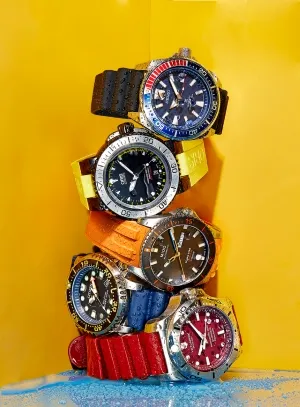
Why the Factory Strap Often Isn’t Enough
Dive watch manufacturers design their factory straps for general use – they need to suit someone buying the watch for casual daily wear as much as someone using it for technical diving. The result is a compromise that performs adequately in most conditions but isn’t optimised for sustained saltwater exposure, UV degradation, or the specific demands of repeated diving.
This is particularly true for dive computers. Garmin, Suunto, and Coros all ship with resin or basic silicone bands designed to be inoffensive to the widest possible market. After 12-18 months of regular diving use, most factory bands show visible degradation – stiffening, cracking at flex points, or persistent odour from salt and biological matter.
The aftermarket offers materials specifically engineered for the conditions divers operate in. Choosing the right one makes a genuine difference over the length of a dive trip or a season of regular diving.
The Materials – Ranked for Diving Use
FKM Fluorocarbon Rubber – the professional standard
FKM is the material Omega uses on the Seamaster Planet Ocean Rubber, Tudor on the Pelagos FXD, and Rolex on the Submariner rubber option. This is not coincidental – FKM fluorocarbon rubber is chemically resistant to seawater, chlorine, UV radiation, sunscreen, and virtually every substance a diver regularly encounters.
The specific properties that matter for scuba diving:
· Chemical resistance – FKM doesn’t react with saltwater, pool chemicals, or the sunscreen and insect repellent divers apply before water entry. Standard silicone and rubber degrade with sustained chemical exposure. FKM doesn’t.
· UV stability – tropical diving means sustained sun exposure on surface intervals and liveaboard decks. FKM maintains its properties under UV exposure where standard rubber compounds become brittle and crack.
· Grip – FKM is firmer than silicone and provides positive grip against the wrist during active water entry, current diving, and drift dives where the watch needs to stay exactly where it was placed.
· Temperature range – FKM performs across the full temperature range divers encounter, from cold water diving in the Pacific Northwest to warm tropical reefs in the Coral Triangle.
· Longevity – a quality FKM strap maintained properly will outlast several sets of standard silicone bands.
The one consideration: FKM is firmer than standard silicone, which some divers find less comfortable on extended surface intervals. This is a personal preference — most divers adapt within a few dives.
Silicone – the versatile everyday option
Medical-grade silicone is the practical choice for divers who want water resistance and easy maintenance without the firmness of FKM. Fully waterproof, hypoallergenic, quick-drying, and easy to clean with fresh water after every dive.
Silicone suits recreational divers, dive instructors who enter the water multiple times daily in tropical conditions, and anyone who wants a single strap that performs across diving and surface activities without requiring thought.
The trade-off versus FKM: silicone has lower chemical resistance and UV stability over extended periods, and provides less grip on the wrist during high-flow conditions. For recreational diving in standard conditions, neither limitation is practically significant.
Single-pass nylon – for travel and backup
Military-spec ballistic nylon in single-pass construction – one continuous piece threading over both spring bars and behind the watch case – is a useful backup strap for travel. If a spring bar fails at depth, the watch stays on the wrist. For technical divers and those diving in challenging conditions, this is worth considering.
Nylon dries rapidly, resists abrasion, and adds almost no weight to the wrist. The limitation: nylon absorbs saltwater and takes longer to fully dry than rubber materials, and sustained saltwater exposure eventually degrades the fibres. Rinse thoroughly with fresh water after every salt dive.
Leather – leave it ashore
Full-grain calfskin is the correct material for a post-dive dinner at the resort restaurant. It is not a diving strap. Leather absorbs saltwater, swells and stiffens, and degrades with repeated water exposure. Even “water-resistant” treated leather is unsuitable for regular diving use.
Choosing for Your Dive Watch or Computer
Lug width, the gap between the watch lugs in millimetres, determines which straps physically fit your equipment.
| Watch/Computer | Lug Width |
| Garmin Fenix 7 / Fenix 8 | 22 mm |
| Garmin Fenix 7X | 26 mm |
| Suunto 9 Peak Pro | 22 mm |
| Coros Vertix 2 | 26 mm |
| Omega Seamaster 300m | 20 mm |
| Tudor Pelagos | 22 mm |
| Seiko Prospex | 20 mm or 22 mm |
| Citizen Promaster | 20 mm or 22 mm |
Measure the gap between your watch lugs before ordering. Larger dive computers – Garmin Fenix 7X, Coros Vertix 2 – typically use 26 mm. Most dive watches and standard GPS computers use 20 mm or 22 mm.
Maintenance
After every salt dive: rinse the strap thoroughly with fresh water. Salt crystals left in the strap material accelerate degradation and cause odour. A 30-second rinse under fresh water is sufficient.
After liveaboard trips: wash the strap with mild soap and rinse thoroughly. For FKM rubber, wipe dry with a clean cloth. For silicone, allow to air dry completely before storage.
Storage: store rubber straps away from direct UV exposure when not in use. FKM is UV-stable but extended unnecessary UV exposure shortens the lifespan of any rubber compound.
Where to Find Quality Dive Watch Straps
Rubber watch straps from CNS Watch Bands include FKM fluorocarbon rubber and medical-grade silicone options across all standard lug widths from 18 mm to 26 mm, covering the full range of dive computers and dive watches currently in use. Available in black, grey, blue, and additional colours. Prices from US$ 9.95, ships worldwide including to liveaboard departure points across Southeast Asia, the Maldives, and the Pacific.
The Practical Recommendation
For serious and regular divers: FKM rubber in the correct lug width. Chemically resistant, UV stable, long-lasting, and the material that the major dive watch manufacturers themselves use on their professional references.
For recreational divers and dive instructors: silicone in the correct lug width. Easier to clean, comfortable for extended wear, fully waterproof, and practical across both diving and surface activities.
Single-pass nylon as a backup for travel – particularly for technical divers or those operating in conditions where equipment security is a priority.
Anna Perras